


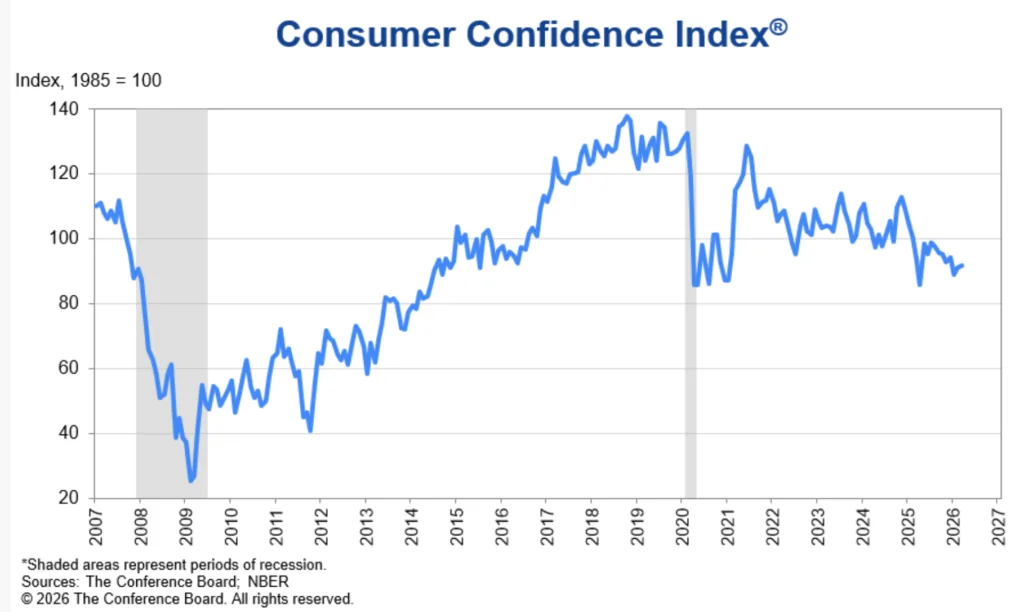
Consumer confidence continued its upward trend in March, with the Conference Board's Consumer Confidence Index edging up by 0.8 points to 91.8 (1985=100), from 91.0 in February. This modest improvement was largely driven by a slight increase in consumers' assessment of current business and labor market conditions, as well as a rise in perceptions of employment conditions. The survey period for preliminary results was March 1 to 24, 2026, which may have influenced the overall trend. Despite this uptick, it's essential to note that consumer confidence has been on a general downward trend since 2021, indicating a lingering impact from past economic challenges.
The Present Situation Index rose again in March, with net views of current business conditions improving to +5.6% after hovering around 1-2% for three months. This represents a significant shift, as consumers' perceptions of employment conditions also improved slightly, with the labor market differential ticking up by 0.1 ppt to +5.8%. However, the Expectations Index dipped, indicating that consumers remain cautious about their economic prospects six months from now.
Demographic trends in consumer confidence are worth noting, particularly among younger generations. For instance, Generation Z remained the most confident among all age groups on a six-month moving average basis, but their optimism slipped in March along with other older generations. In contrast, Millennials cited improved confidence in March, suggesting that this demographic may be bucking the trend.

The impact of rising costs due to tariff passthrough and spiking oil prices is evident in various measures, including inflation expectations. While not directly reflected in the headline or its component indexes, these factors suggest that consumers are increasingly concerned about their economic prospects.
Despite some segments showing optimism, consumer confidence remains a mixed bag. The slight improvement in March may be attributed to a modest shift in consumers' views of current conditions, but it's essential to consider the overall trend and potential underlying factors.
The weight of rising costs is evident among various measures, including inflation expectations. This suggests that consumers are becoming increasingly cautious about their economic prospects six months from now.
Consumer confidence by political affiliation remains a telling indicator of the state of the economy. Republicans remain the most optimistic, while confidence is substantially lower among Independents and the lowest among Democrats.
The general downward trend in consumer confidence since 2021 underscores the ongoing impact of past economic challenges. It's essential to consider this context when analyzing the latest data.
Ultimately, the slight improvement in consumer confidence in March may be a welcome sign for policymakers and businesses alike. However, it's crucial to address the underlying factors driving consumer uncertainty and ensure that the economy remains resilient in the face of rising costs and other challenges.
The slight improvement in consumer confidence is a mixed bag, with some segments showing optimism and others still struggling with rising costs.