
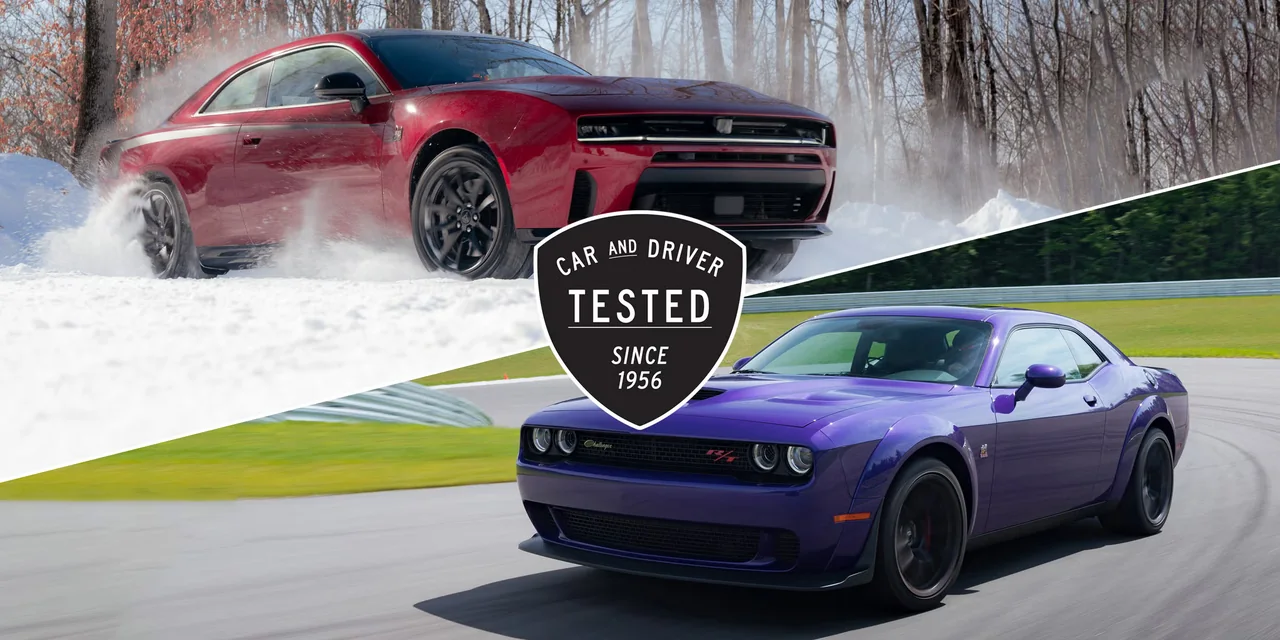
The Dodge Challenger left the lineup after the 2023 model year, leaving its successor, the Charger Sixpack Scat Pack Plus, to prove itself in comparison.
A lot has changed since then, with Dodge no longer offering a V-8 engine option for its muscle cars. The new Charger features a 550-hp twin-turbo 3.0-liter straight-six engine, dubbed the Hurricane.
The old Challenger we tested was powered by a 485-hp naturally aspirated 6.4-liter V-8, known as the famous 392 Hemi. Unfortunately, the Charger Sixpack performed worse than its predecessor in some key performance metrics.

On our skidpad, the Charger posted just 0.90 g compared to the Challenger's 0.96 result. Similarly, a hard stop from 70 mph required 177 feet for the Charger and 148 feet for the Challenger.
The weight difference between the two cars is also worth noting, with the Charger Sixpack weighing in at 4889 pounds and the Challenger R/T Scat Pack tipping the scales at 4352 pounds. This significant weight penalty likely contributed to the Charger's poor performance.
Despite being heavier, the Charger Sixpack still managed to accelerate from 0-60 mph in 3.7 seconds, two-tenths ahead of the V-8 Challenger. However, it took longer to reach 100 mph, with an 8.8-second run compared to the Challenger's 9.3 seconds.

The new twin-turbo Charger also recorded a quicker quarter-mile time of 12.1 seconds at 116 mph, although the Challenger still managed a respectable 12.4 seconds at 114 mph.
It seems that the shift to a twin-turbo six-cylinder engine and heavier weight penalty have significantly impacted the new model's performance. The Charger's poor acceleration and braking times suggest that it may not be the best option for those seeking a high-performance driving experience.
In contrast, the Challenger's V-8 engine proved to be more reliable in these tests, with its impressive straight-line speed and quarter-mile time making it a formidable competitor in the muscle car segment.
The shift to a twin-turbo six-cylinder engine and heavier weight penalty have significantly impacted the new model's performance.