


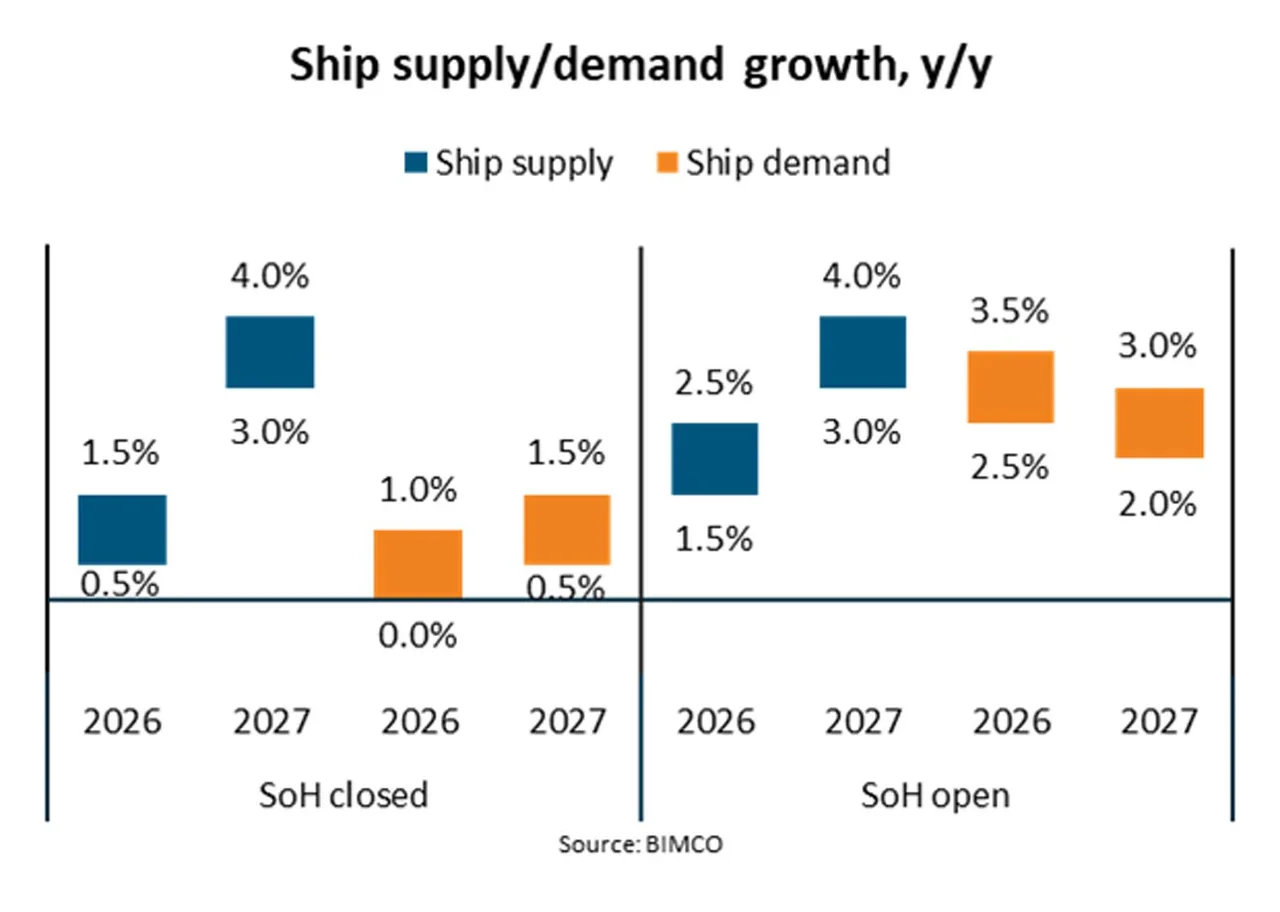
The Iran war and resulting disruptions to ship transits through the Strait of Hormuz have increased uncertainty for both the global economy and the dry bulk market. Around 4% of dry bulk cargoes and tonne mile demand typically sail through the strait, but currently, around 210 ships are trapped in the Persian Gulf.
Given the high uncertainty over when transits may resume, two forecast scenarios have been presented: the ‘SoH closed’ scenario assumes the strait remains effectively closed indefinitely, while the ‘SoH open’ scenario assumes an imminent reopening. The longer the closure persists, the closer the market outlook will align with the SoH closed scenario.
If the strait remains effectively closed, the supply/demand balance is expected to weaken slightly in 2026, albeit from a high baseline, and to weaken significantly in 2027.
However, if transits resume soon, the forecast suggests that market conditions will remain strong during this and next year, as the supply/demand balance strengthens in 2026 and slightly weakens in 2027.
Supply growth is expected to be broadly similar under both scenarios, with fleet supply forecast to grow by 0.5-1.5% in 2026 and by 3-4% in 2027.
High deliveries in the panamax and supramax segments are driving fleet growth, while ship recycling is expected to remain low.
Differences between the scenarios are more pronounced on the demand side, with demand expected to grow by up to 1% in 2026 under the SoH closed scenario.
If the strait reopens, demand growth is forecasted to be around 2.5 pp higher in 2026 and 1.5 pp higher in 2027, driven by stronger minor bulk and grain volumes.
The expected arrival of El Niño adds another uncertainty to the dry bulk demand outlook, with weather impacts potentially disrupting Panama Canal transits and affecting grain harvests unevenly across regions.
The longer the Strait of Hormuz remains closed, the closer the market outlook will align with a weaker supply/demand balance.