


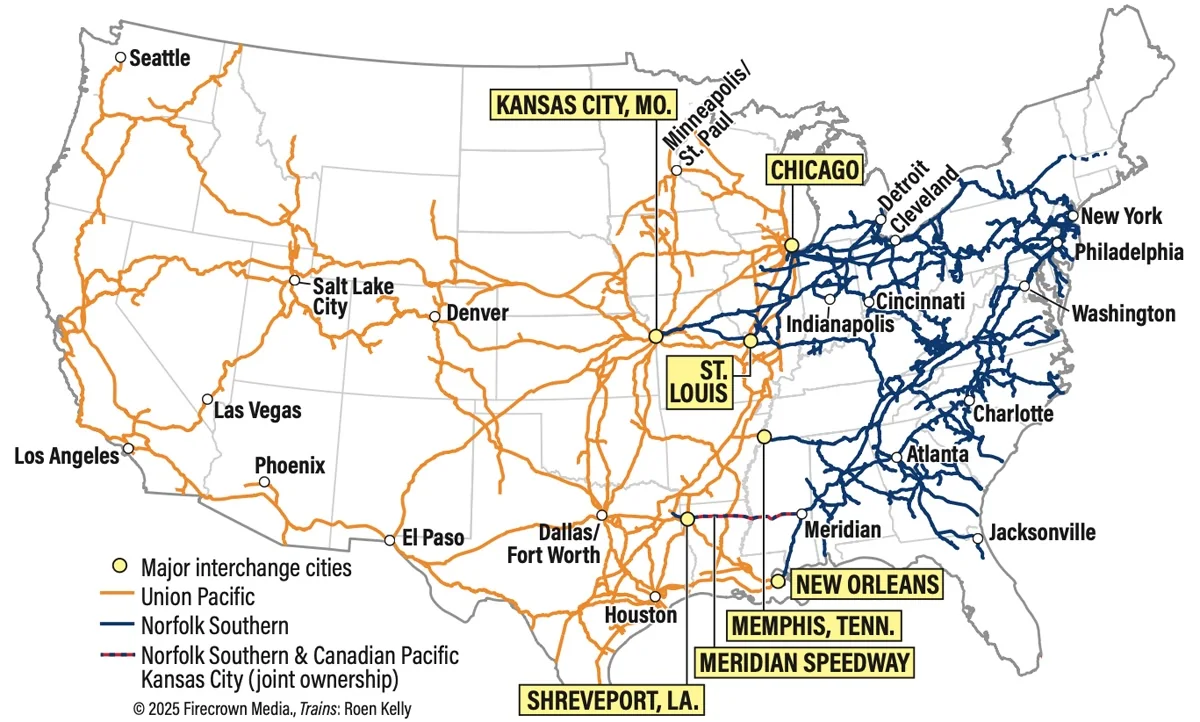
The proposed merger between Union Pacific and Norfolk Southern is facing a significant challenge due to regulatory conditions.
If federal regulators order widespread trackage rights or line sales as part of their approval, Union Pacific will walk away from the deal.
This could have major implications for the rail industry, as the combined railroad would create a transcontinental rail network with over 52,000 miles of track in 43 states.

The merger agreement was disclosed on Thursday in the revised merger application filed with the Surface Transportation Board.
The consolidation would give Union Pacific a pair of routes between Kansas City and St. Louis, including its former Missouri Pacific via Jefferson City, Mo., and Norfolk Southern's former Wabash via Moberly, Mo.
Union Pacific has offered affected customers the ability to receive service from another Class I railroad if they currently use rail service.
However, the company will not grant other railroads wide access to its or Norfolk Southern's routes via line sales, trackage rights, or haulage rights.
This means that any line sale required as part of regulatory approval of the deal is an automatic condition that would allow Union Pacific to scuttle the merger.
The company has agreed only to proportional revenue rate agreements for manifest carload traffic interchanged through certain cities.
Under the merger agreement, there is no freestanding right for Union Pacific to terminate the deal the moment the STB announces an unacceptable condition.
However, if burdensome conditions prompt Union Pacific to walk away, it will have to pay Norfolk Southern a $2.5 billion breakup fee.
Either railroad can terminate the deal if it isn't closed by January 28, 2028 or if the Surface Transportation Board or a court issues a final decision blocking the merger.
The end date automatically extends if the STB adds time to its review clock.
This added complexity highlights the challenges of regulating large mergers in the rail industry.
Regulatory conditions can significantly impact the success of large mergers like this one.