

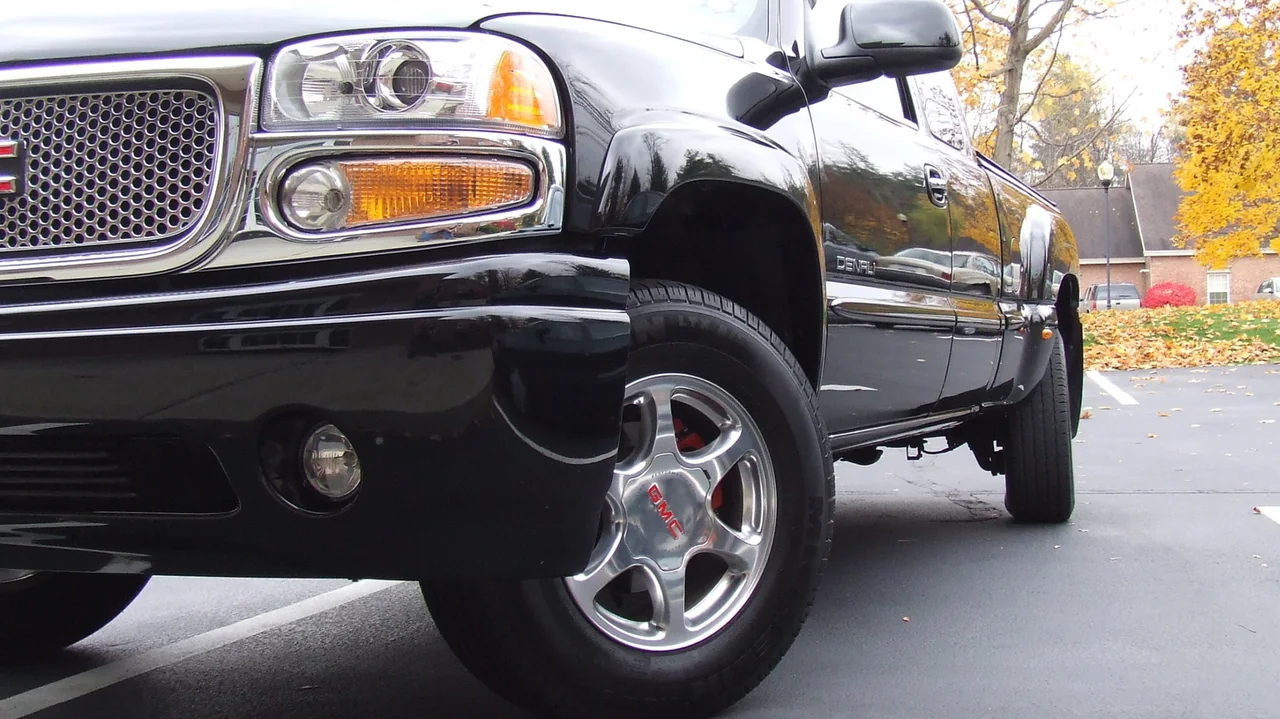
General Motors' Quadrasteer system was a groundbreaking innovation in the automotive industry, offering improved four-wheel steering capabilities for its GMT800 lineup of pickup trucks and SUVs. Developed in collaboration with Delphi Automotive, Quadrasteer was standard in the 2002 GMC Sierra Denali, delivering exceptional maneuverability when parking or towing.
The system worked wonders, reducing the truck's turning diameter to 37.4 feet, making it highly responsive in tight spaces. However, these capabilities came at a significant cost that ultimately proved too high for consumers.
Quadrasteer was essentially a Dana 60 rear axle with a rack-and-pinion assembly, an electric motor, and an array of sensors, featuring three driver-selectable modes: 2-wheel steer, 4-wheel steer, and 4-wheel steer tow. The system's performance was impressive, but its price tag was a major deterrent.

The Quadrasteer system's ability to adapt to different driving conditions was a significant advantage, with the rear wheels turning up to 12 degrees opposite the front at low speeds and reducing the steering angle between 7 and 40 mph. At high speeds, the system turned the rear wheels about 5 degrees in the same direction as the front wheels.
This level of control and responsiveness made Quadrasteer an attractive option for drivers who valued maneuverability and stability. However, its high price point of $7,000 was a significant barrier to adoption.
In contrast to earlier four-wheel steering systems that failed to offer consistent handling improvements over conventional two-wheel steering, Quadrasteer's performance was more impressive. Nevertheless, the system's expense made it inaccessible to many consumers.
The failure of GM's Quadrasteer system to gain widespread acceptance highlights the challenges of introducing innovative technologies in the automotive industry. Despite its potential benefits, the system's high cost ultimately proved too much for consumers to overcome.
While Quadrasteer was an impressive innovation, its failure serves as a reminder that technological advancements must balance performance with practicality and affordability.
The legacy of GM's Quadrasteer system continues to influence modern four-wheel steering systems, which have become more prevalent in the automotive industry. However, its impact on consumer adoption remains a cautionary tale for manufacturers seeking to introduce innovative technologies.
While innovative, GM's Quadrasteer system failed to gain widespread adoption due to high costs.