
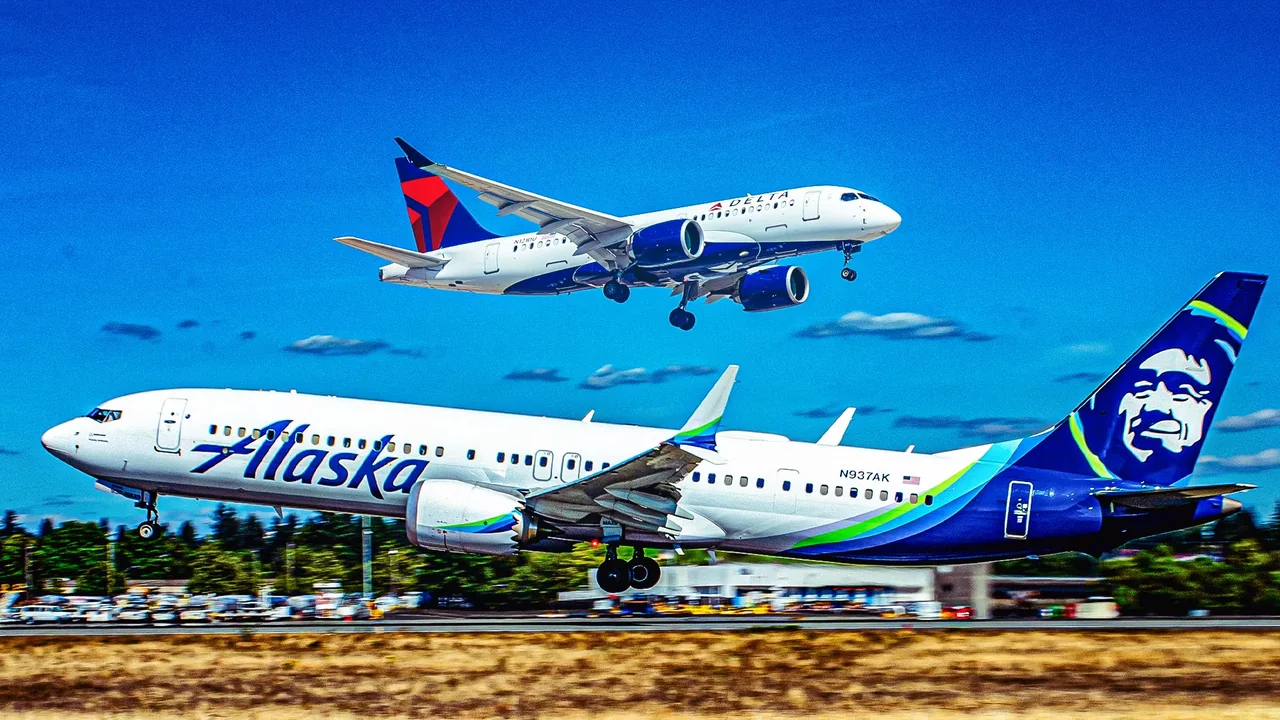
The Airbus A220 is widely considered the quietest commercial aircraft in production today, with a significantly reduced noise footprint and perceived level compared to its competitors.
This advantage comes at the cost of being much larger than some single-aisle jets, but its smaller package also gives it an edge in terms of noise reduction.
The Boeing 737 MAX, on the other hand, is praised for being 50% quieter than its predecessor, the 737 Next Generation series, with a takeoff average of around 70 decibels.

However, when compared to the Airbus A220-300, it doesn't come close in terms of noise reduction, with an 18-decibel difference on takeoff.
Studies have shown that this difference is large enough for observers to perceive the Airbus as being much quieter from the ground, with a level of 90 decibels compared to the Boeing's 108 decibels.
For context, this is equivalent to standing in the middle of a quiet library or the corner of a busy street with trucks driving by at full speed.

Inside the cabin, passengers have also reported a noticeable difference in sound levels on the A220 compared to the 737 and even the Airbus on the A320 single-aisle jetliner family.
The power plants used in these aircraft are the source of the sound difference during takeoff, with the Pratt and Whitney PW1500G engine producing a unique whine due to its design.
This reduces the roaring sound heard from other turbofan engines because of the lower velocity airflow, resulting in a more muffled sound.

The Boeing 737 MAX is powered by CFM International LEAP-1B engines with chevron-shaped nacelles that help reduce turbulent sounds and specific sound frequencies.
The power plants used in these aircraft are a significant factor in the noise reduction.