


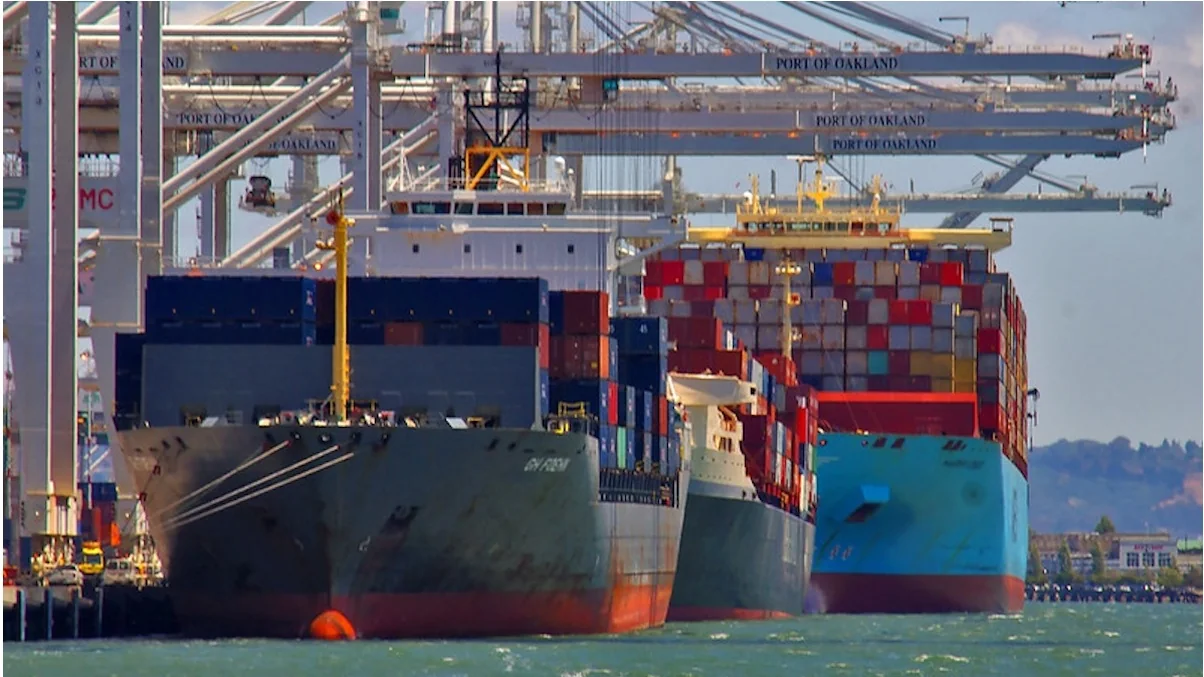
The Port of Oakland, California, has reported a stable cargo activity level in April, with 184,492 twenty-foot equivalent units (TEUs) handled at the port. This marks a significant improvement compared to March, where cargo volume edged down by 198,667 TEUs due to fewer vessel calls. The port's throughput resilience is attributed to its diverse cargo mix and ability to adapt to evolving global shipping patterns.
The port's performance in April reflects a combination of factors, including reduced vessel calls, adjustments in carrier scheduling, and typical month-to-month cargo fluctuations. Despite these challenges, cargo volumes remained relatively stable, indicating a trend towards larger vessel exchanges and increased cargo movement per call.
Oakland's diverse cargo mix plays a crucial role in its ability to weather volatility across trans-Pacific trade markets. The port serves as a gateway for agricultural exports and Northern California commerce, making it an essential hub for the region's economic activities.

The port's stability is also attributed to its ability to navigate changes in global shipping patterns. With the rise of larger vessels and increased cargo movement per call, ports like Oakland are well-positioned to capitalize on these trends and maintain their competitiveness.
According to Maritime Director Bryan Brandes, Oakland's diverse cargo mix helps the hub weather volatility across trans-Pacific trade markets. The port's ability to adapt to changing market conditions is essential in maintaining its position as a leading cargo hub.
The Port of Oakland's performance in April serves as a reminder of the importance of flexibility and resilience in the face of uncertainty. As global shipping patterns continue to evolve, ports like Oakland will be crucial in navigating these changes and ensuring the smooth flow of goods.
Despite a 5.7% decline in year-to-date volume through April compared to the same period in 2025, the port's performance remains encouraging. This suggests that Oakland is well-positioned to recover from past challenges and maintain its position as a leading cargo hub.
The Port of Oakland's stability is also reflected in its total cargo volume, which slipped only 0.5% from the same month a year ago. This indicates that shippers are continuing to rely on the port for their cargo needs, even in the face of uncertainty.
Overall, the Port of Oakland's performance in April demonstrates its ability to adapt to changing market conditions and maintain its position as a leading cargo hub. As global shipping patterns continue to evolve, ports like Oakland will be crucial in navigating these changes and ensuring the smooth flow of goods.