

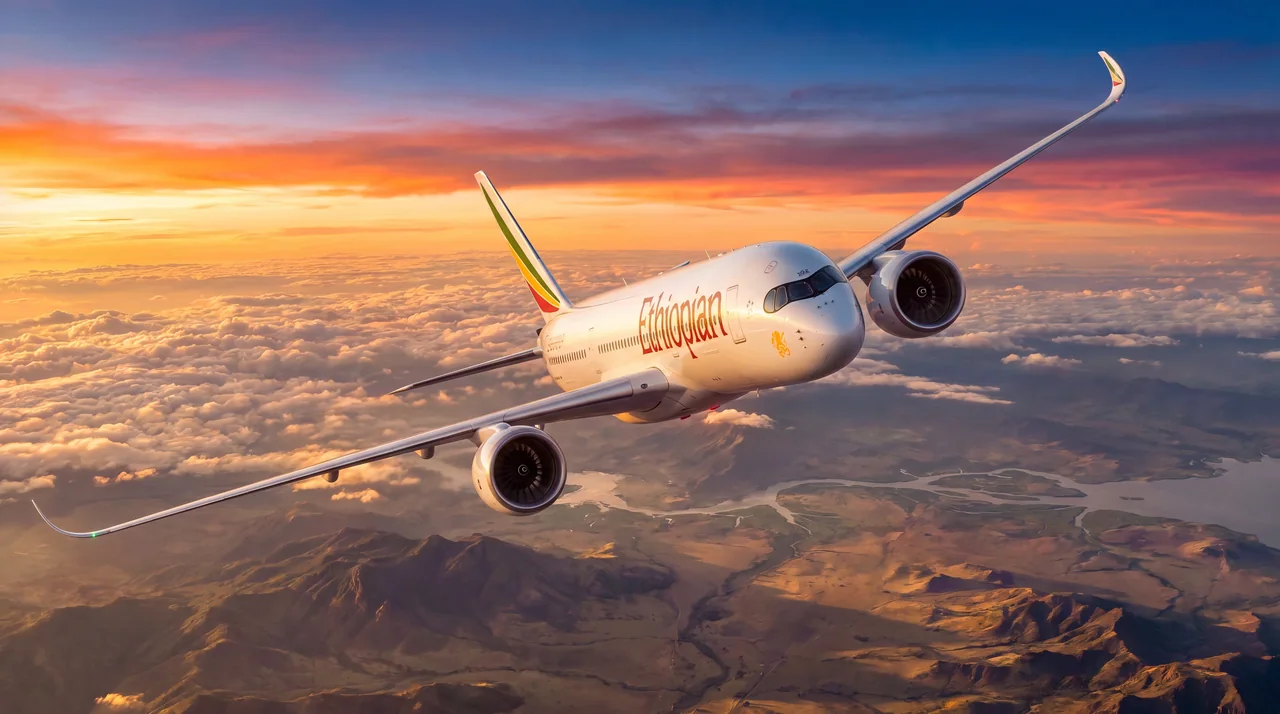
Ethiopian Airlines has announced its plans to operate 10 new ultra-long routes in 2026, with the longest nonstop passenger service clocking in at 18 hours and 30 minutes.
The airline's schedule submission to OAG reveals a comprehensive approach to passenger operations, combining nonstop and one-stop services to provide a complete picture of its passenger operations.
Block time, which includes taxi time, flight time, and delays, is a key factor in determining the length of flights. Ethiopian Airlines' block times range from 14 hours to 18 hours and 30 minutes, with the longest service operating between Washington Dulles International Airport (IAD) and Lomé–Tokoin International Airport (LFW).

The airline's use of the Boeing 787-8 is a common thread among its ultra-long routes, with multiple services timed at up to 18 hours.
Ethiopian Airlines' longest service operates three times weekly between IAD and LFW, using the 270-seat Boeing 787-8. The carrier also serves IAD with a stop in Rome Fiumicino Airport (FCO), which is used by most flights due to ADD's high elevation.
The airline's expansion into ultra-long-haul flights is driven by growing demand for global connectivity, particularly between the US and African markets.

Booking data shows that passengers are increasingly flying between IAD and cities in Central and West Africa, such as Accra and Lagos. Ethiopian Airlines' new longest service offers a convenient option for these travelers.
The airline's return to Hartsfield-Jackson Atlanta International Airport (ATL) after suspending flights earlier this year is also noteworthy, despite its poor performance in the US market in 2025.
Overall, Ethiopian Airlines' expansion into ultra-long-haul flights reflects the growing trend of increased connectivity and global travel.

The airline's use of technology, such as automated systems for flight planning and management, has enabled it to optimize its operations and reduce delays.
The expansion of ultra-long-haul flights is a significant trend in the aviation industry, driven by growing demand for global connectivity.