

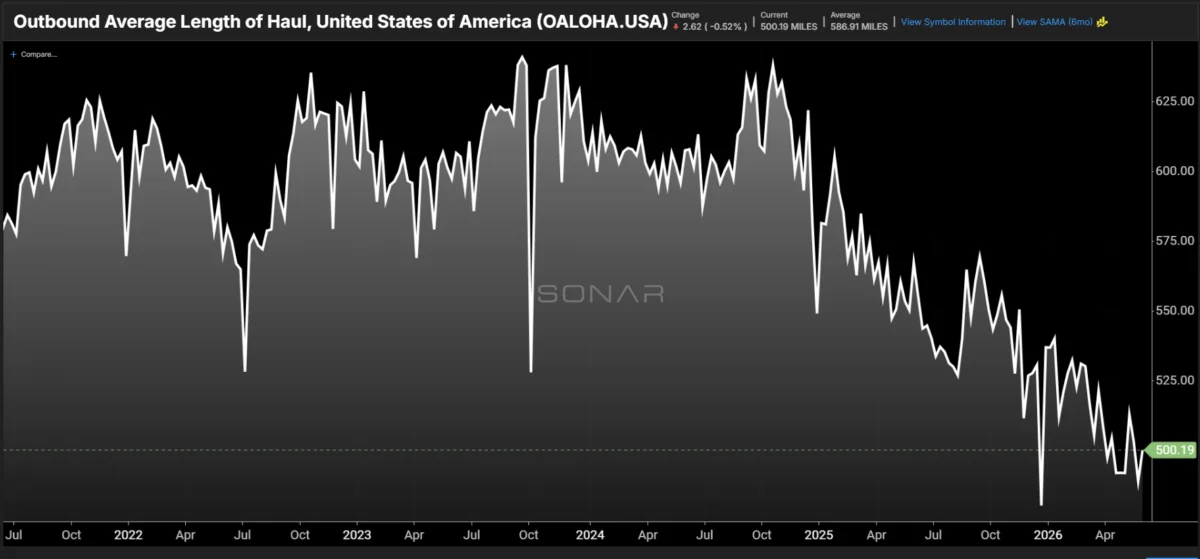
The trucking industry is experiencing a significant trend of shrinking load lengths, with the average haul length decreasing by 21% since June 2024. This decline has been steady, with 11% of that decrease occurring over the past year alone. The impact of this trend on the industry cannot be overstated, as it affects capacity utilization and market conditions.
The trucking industry is facing a complex set of challenges, including tightening domestic truckload markets and the rise of intermodal transportation. As shippers adapt their supply chain management strategies, they are increasingly utilizing trucks for shorter distances, resulting in reduced load lengths.
Longer hauls occupy more capacity, as a single truck's time can be fully utilized by a longer distance. However, despite the decline in load lengths, tender rejections remain high at multi-year highs above 17%, and spot rates are surging across all three main trailer types.
The data suggests that intermodal transportation is playing a significant role in the trend of shrinking load lengths. Intermodal has a strong cost advantage over trucking on longer transcontinental lanes but struggles to compete on shorter distances.
Intermodal lost share to trucking during the pandemic, when it couldn't keep pace with demand. Since then, railroads and carriers have invested in infrastructure and expanded capacity to handle greater volume and demand surges.
The growth of international container volumes is a direct derivative of imports, as containers are loaded from ships and port yards directly onto trains. Domestic container volumes are typically originated in the U.S. and are transloaded at warehouses.

Intermodal has a cost advantage, but service favors trucking due to its ability to move directly in and out of shipper facilities with fewer touchpoints. Intermodal contract savings averaged between 10% and 20% in 2024 and 2025, but that gap has widened rapidly this year as truckload rates have climbed.
The trend of shrinking load lengths may be a permanent alteration of the market, driven by industry shift in supply chain management strategies. This could have significant implications for the trucking industry's capacity utilization and market conditions.
As the industry continues to navigate these challenges, it is essential to understand the underlying drivers of this trend and how they will impact the future of trucking.

The data from SONAR suggests that the trend of shrinking load lengths is unlikely to reverse in the near future. With 11% of the decline occurring over the past year alone, it appears that the industry is experiencing a sustained structural change.
Industry shift in supply chain management strategies may be permanent.