

A new study examines the 'industrial opportunity cost' of proposals to weaken EU car CO2 targets. The growing electric car market, much investment into EV production, batteries and components has been announced. However, this is now at risk as the EU debates its car CO 2 rules that will define the size of the market.
From China to Chile, battery electric vehicles (BEVs) are now the growth engine of the global automotive industry, accounting for the vast majority of new investment, innovation and model launches. If Europe anchors BEV manufacturing — including batteries, power electronics, and critical components — within its borders, it can rebuild its industrial base, increase its domestic gross value added (GVA) and secure growth and jobs.
However, the risk today is industrial decline through strategic hesitation. Despite much investment announced and affordable mass-market BEVs finally hitting showrooms, the EU is once again proposing to revise its 2030–2035 car CO 2 rules (which define the size of the EV market). Compared to the current regulation, the new Commission proposal weakens both the 2030 and 2035 targets, while the auto industry wants to reduce that ambition even more.
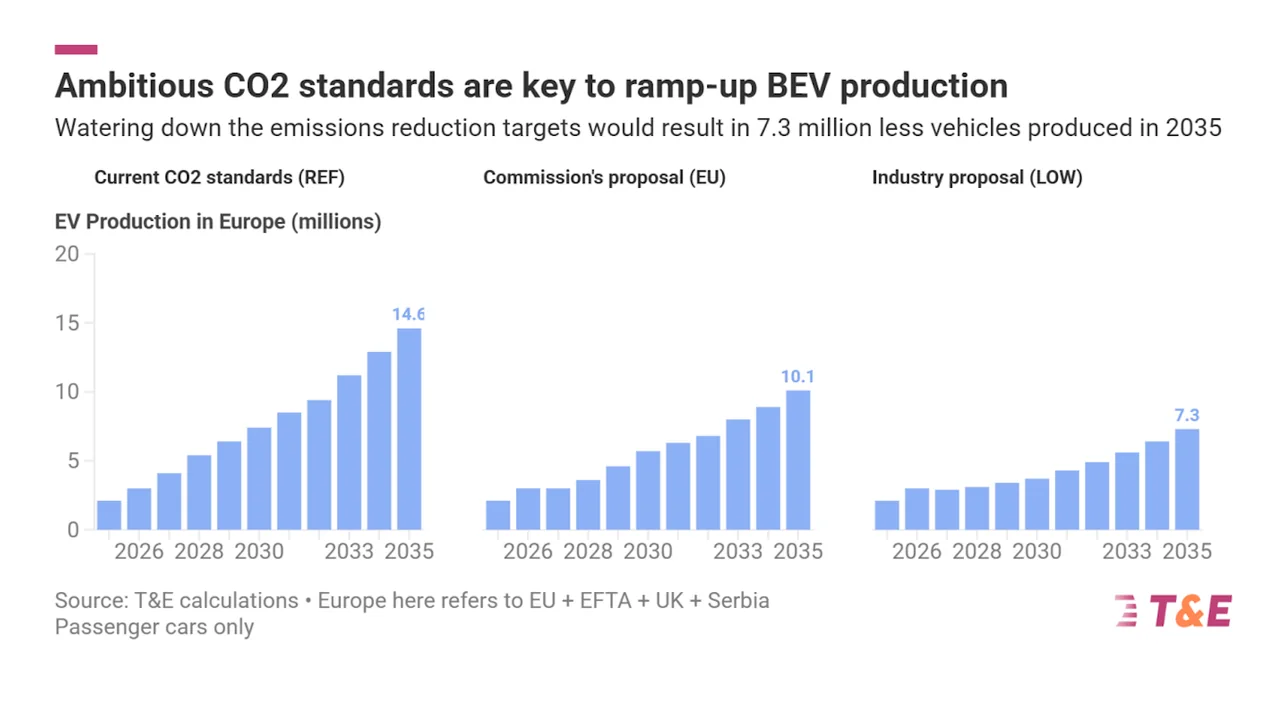
The proposed changes could result in significant reductions in battery capacity and investment. In 2030, BEV production will halve compared to today's projections if the auto industry amendments are adopted. The Commission proposal would also lead to a significant reduction in BEV production, with only 5.7 million units produced instead of the current estimate of 7.4 million.
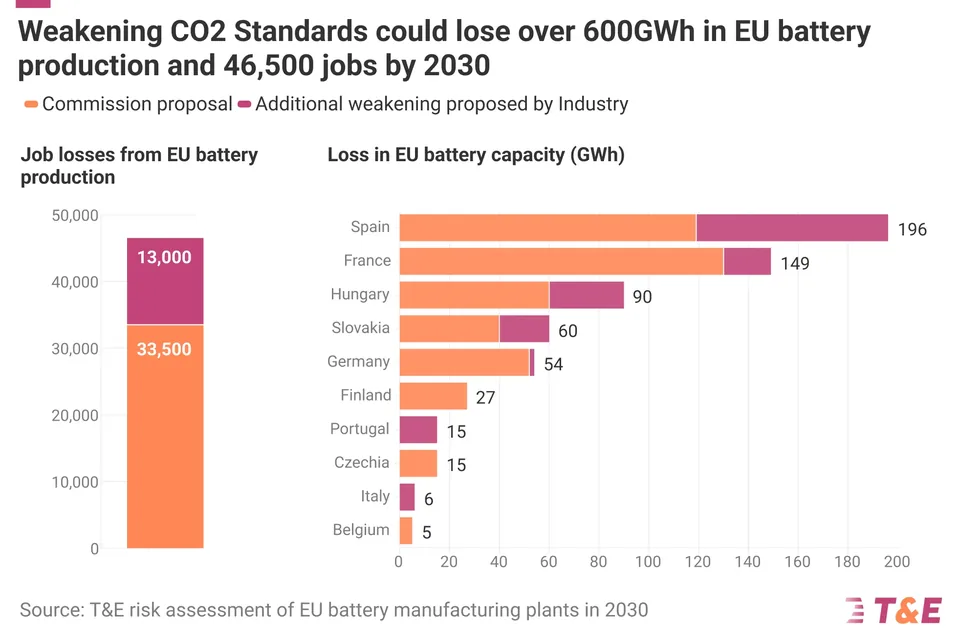
The impact on the industry is severe, with over 34 Northvolt-sized battery factories not being built and up to 47,000 jobs lost if the auto industry amendments are adopted. The current name-plate capacity of all battery plants will reduce by 56% in 2030 under the Commission's proposal scenario.
The study estimates the industrial opportunity costs for BEV production, as well as battery and its value chain investment from these proposals. To do so, T&E uses three scenarios: the current CO 2 regulation (REF), the Commission proposal (EU) and the auto industry position (LOW).
Aside from the car emission rules, the industrial policy — notably the recently proposed Industrial Accelerator Act (IAA) is critical to ensure the EV market brings a local manufacturing base. The IAA aims to support the development of domestic industries and promote economic growth.
The EU's decision on car CO2 targets has significant implications for the electric vehicle market and its associated industries. The proposed changes could lead to a decline in investment, job losses, and reduced economic growth if not addressed.
Ultimately, it is crucial that the EU takes a comprehensive approach to address the concerns of both industry stakeholders and environmental groups. A balanced approach that promotes sustainable growth and reduces carbon emissions is necessary to ensure the long-term success of the electric vehicle market.
The EU's decision on car CO2 targets has significant implications for the electric vehicle market and its associated industries.