


The Trump administration's Jones Act waiver is a small policy exception with a much larger lesson. The same administration that says it wants to restore American maritime dominance, rebuild domestic shipbuilding, counter China's industrial scale, and make U.S. logistics more secure also waived parts of the law usually treated as the foundation of that domestic maritime system.
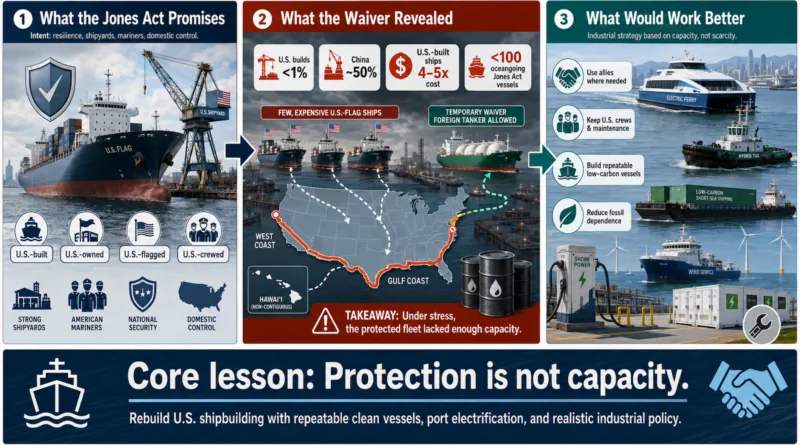
The Jones Act is simple in its core requirement and complex in its effects. Cargo moved by water between U.S. points must generally travel on vessels that are U.S.-built, U.S.-owned, U.S.-flagged, and U.S.-crewed. The stated purpose is resilience. The law is meant to preserve domestic shipbuilding, trained merchant mariners, control over domestic logistics, and sealift capacity in wartime or crisis.
Protection can preserve a market. It cannot, on its own, create industrial competitiveness. That distinction sits at the heart of the Jones Act debate. The United States has protected a domestic shipping market for more than a century, but it has not converted that protected market into a large, modern, globally competitive commercial shipbuilding sector.
China builds roughly half of the world's commercial ships. South Korea and Japan remain major shipbuilding powers. The United States builds less than 1% of global commercial tonnage. That is a rounding error in a maritime-power contest. It exposes the gap in United States ambitions compared to economic reality.
U.S.-built commercial vessels cost several times more than similar ships from Asian yards. Econofact has summarized the cost gap as four to five times higher for large merchant ships built in the United States compared with comparable Asian-built vessels.
The oceangoing Jones Act fleet has also shrunk. It is small, specialized, expensive, and unevenly available. The law has preserved some domestic maritime work, and that work matters to real companies, workers, ports, and communities.
However, protected scarcity is still scarcity. If the fleet is too small, too costly, or unavailable on the needed route, the country does not have resilience just because the law says it should.
The waiver was not repeal. It was not a general liberalization of U.S. cabotage. It was a temporary exception for selected domestic cargoes. The administration's decision highlights the need to reevaluate the Jones Act's role in American maritime policy.
Ultimately, the Jones Act waiver serves as a wake-up call for policymakers and industry leaders to address the significant gap between U.S. shipbuilding ambitions and economic reality.
The Jones Act waiver highlights the need for a comprehensive strategy to rebuild American shipbuilding and address global competitiveness.