

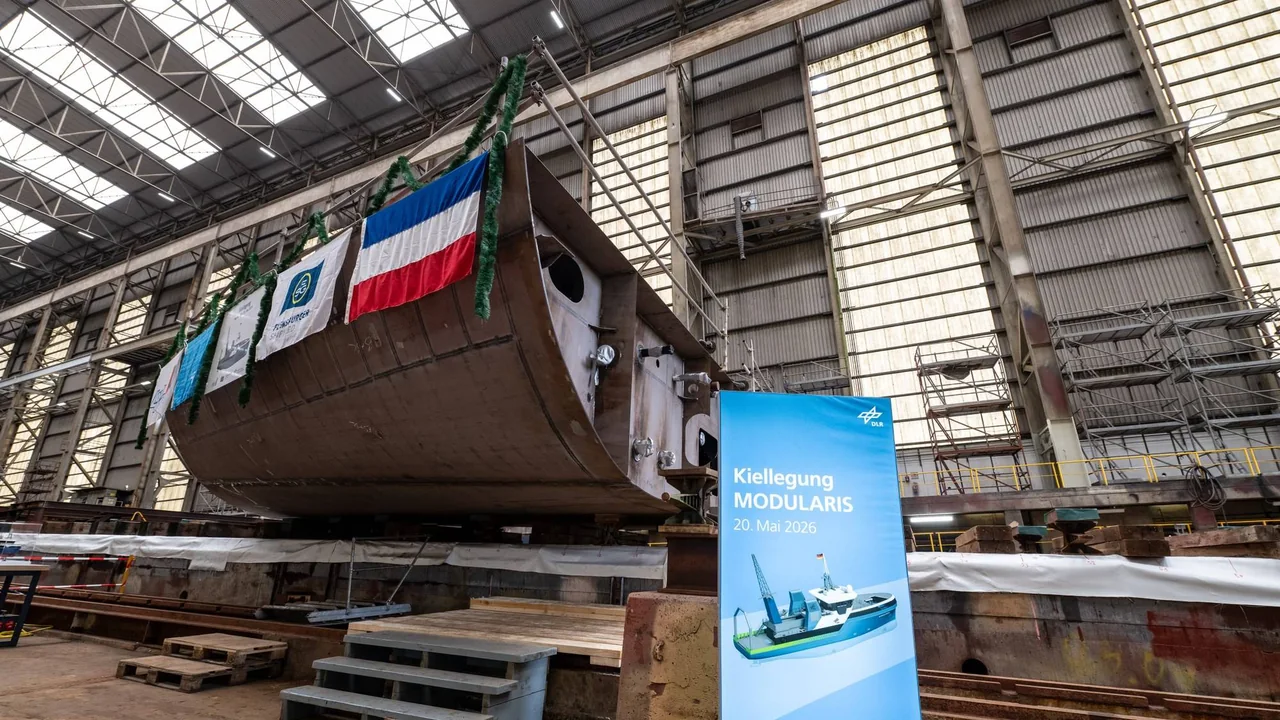
Germany's German Aerospace Center (DLR) has celebrated the keel-laying of its seagoing technology platform at the FSG Shipyard in Flensburg. The ship, named Modularis, will serve as a floating laboratory for testing innovative maritime technologies under real operating conditions at sea. This marks an exciting milestone in DLR's efforts to develop climate-compatible propulsion systems and autonomous technologies for the maritime sector.
The name 'Modularis' combines the adjective 'modular' with the Latin noun 'maris,' reflecting how DLR intends to use the platform: to test innovative technologies flexibly and under real operating conditions at sea. This approach will enable the development of novel energy systems, navigation, and communication systems that can be certified for widespread adoption.
The German government is providing €36 million in funding for this ambitious project, which aims to accelerate innovation in the maritime sector. The vessel's focus on climate-compatible propulsion systems, autonomous technologies, and security applications underscores the importance of sustainable and efficient solutions for the future of shipping.
Modularis will be 48 meters long and 11.5 meters wide, with capacity for up to 20 people on board. Test voyages are planned primarily in the North Sea, Baltic Sea, and Mediterranean, with missions lasting up to seven days. These test voyages will provide valuable insights into the performance of novel energy systems under real-world conditions.
The vessel will be equipped with redundant safety and control systems, enabling the testing of as-yet uncertified energy, navigation, and communication systems for the first time. This will significantly accelerate development and certification processes for innovative maritime technologies.
A digital twin will also allow comprehensive simulations and analyses to prepare for and complement practical development work. This cutting-edge approach will enable researchers to test and refine their ideas before deploying them on board Modularis.
On board, DLR researchers will test fuel cell, battery, sensor, and automation systems, among other technologies. They will also trial the use of alternative fuels such as methanol, ammonia, and hydrogen, for which the vessel will be fitted with an experimental engine room.
The platform will support the deployment of uncrewed systems such as drones, further expanding the scope of innovation on board Modularis. This will enable researchers to explore new applications and test novel technologies in a real-world setting.
Lloyd Werft Bremerhaven is leading the construction of the maritime technology platform, with FSG Shipyard in Flensburg subcontracting the hull construction. The vessel will be transferred to Bremerhaven in autumn, following its completion in 2027, when it will have its home port in Kiel.
The seagoing technology platform will accelerate development and certification processes for innovative maritime technologies.