

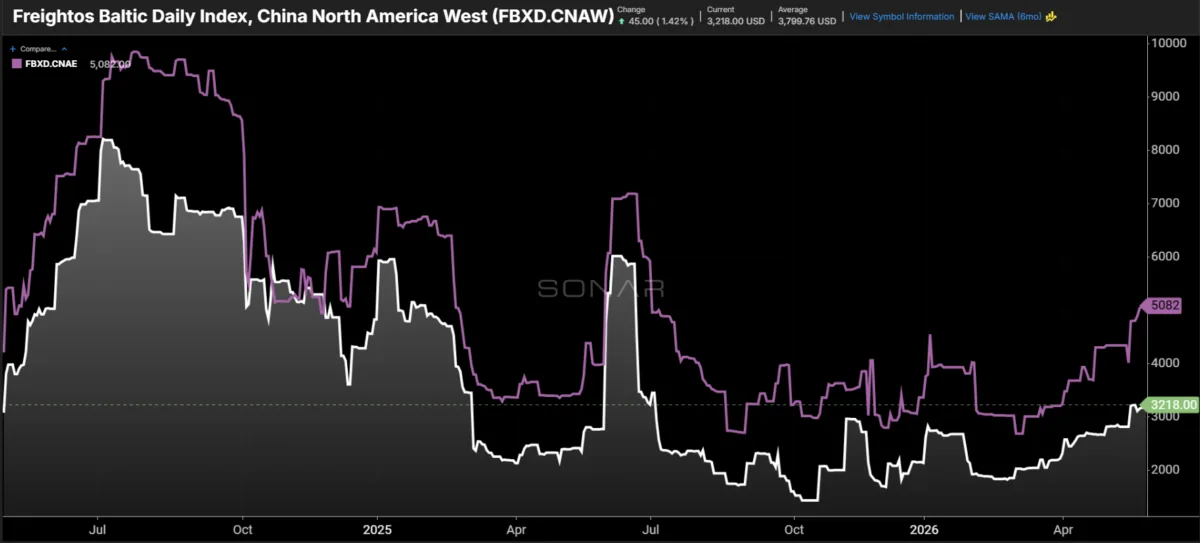
The ocean container shipping market has not been a major factor in the recent domestic freight market turbulence, but it's about to become a significant player. As the global economy continues to recover from the pandemic, the impact of the ongoing conflict in Iran is starting to be felt on the East Coast. Spot rates for 40-foot equivalent containers moving from China to North America's East Coast have nearly doubled since late February, rising from $2,600 to over $5,000.
This surge in spot rates is largely driven by fuel costs, which are a major expense for shipping companies. With capacity remaining ample and shippers adapting to longer transit times, the market seems to be managing the increases relatively well. However, this could be a sign of things to come as we inch closer to peak import season.
The trans-Pacific route has also seen significant increases, rising by $1,400 over the same period to $3,200 as of this past week. Both lanes have experienced more than a 75% increase over an eight-week period, according to the Freightos Baltic Daily Index (FBXD).
Maritime shipping disruptions have been a major factor in supply chain management strategies since the pandemic. During the height of the COVID era, importers flooded ports and railheads, congesting and ultimately breaking the infrastructure.
This led to a shift in transcontinental freight share from rail to truck. As recently as 2024, railroads were able to reclaim a large portion of transcontinental volumes as shippers extended their order lead times over concerns that Red Sea attacks were deteriorating service globally.
With overseas transit times a growing concern, shippers pushed order lead times to their highest levels since the end of COVID during the summer of 2024. Ocean transit times averaged approximately five days longer — published schedules plus delays — in July 2024 versus July 2023.

Order lead times of 21 days more than doubled during that period, meaning a significant amount of freight had weeks to move domestically. This excess time favored intermodal traffic. Inventory management has shifted back toward a more just-in-time approach as warehousing costs are now significantly higher than they were a few years ago.
Suez Canal diversions have largely remained in place since early 2024, but lead times have since dropped, though not back to 2023 lows. Tariff uncertainty brought a new level of disruption to the ocean market in 2025, just as supply chains and maritime carriers had adapted to the Houthi attacks.
Spot rates were largely lower than in 2024, save for a short-lived spike in June when the most prohibitive tariffs on Chinese goods were eased. This triggered the strongest pull-forward and replenishment event in the post-COVID era, though the market managed it relatively well as rates softened quickly in July.

The ongoing conflict in Iran is creating a slow burn in spot rates as we inch closer to peak import season.