
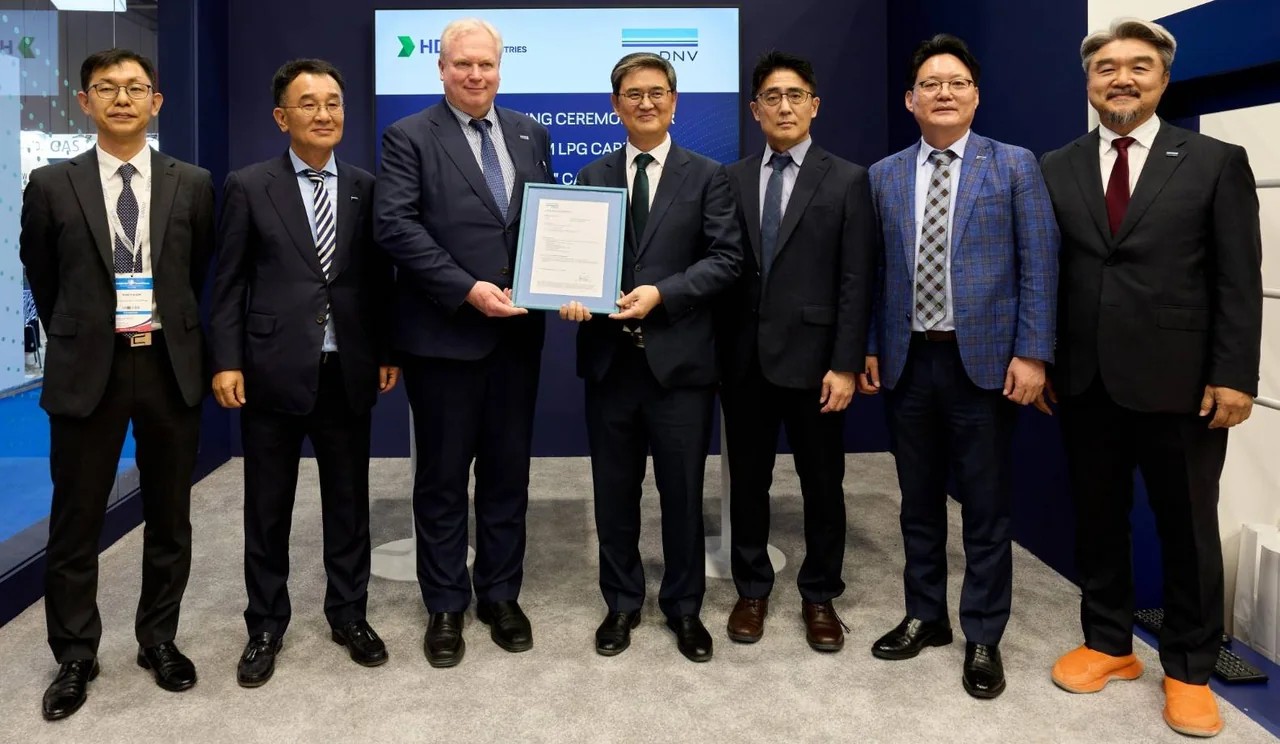
Global shipping giant Hyundai Heavy Industries (HHI) has taken a major leap forward in the design of gas carriers, with DNV awarding an Approval in Principle (AiP) for its independent Type B LPG cargo tank design. This innovative design is intended to improve operational safety and maintenance accessibility throughout a vessel's service life, while providing greater flexibility in the selection of inner hull materials during the design stage. The use of Type B tanks in very large gas carriers (VLGCs) is a significant development in the maritime industry.
The approval covers HHI's design for a 90,000-cubic-metre independent Type B containment system for LPG carriers. This advanced design incorporates crack propagation and fatigue analyses in addition to the buckling and sloshing assessments typically carried out for Type A tanks. The result is a more reliable and safer vessel that can withstand the rigors of long-distance travel.
The safety features of HHI's design are noteworthy, with a partial secondary barrier in the form of a leak path acting as a spray shield over welded areas. This feature provides an additional layer of protection against potential leaks or spills. Four dedicated drip trays per tank are also designed to contain leakages and protect the surrounding hull structure.
The use of Type B tanks in VLGCs is a response to the need for more adaptable gas carrier solutions. By incorporating advanced structural reliability features, HHI's design can prevent the propagation of surface defects through the tank wall over its design life. This reduces the risk of accidents and ensures that vessels remain seaworthy throughout their service life.
DNV's AiP builds confidence in HHI's design and marks a significant milestone in the development of safer gas carrier solutions. The certification process is rigorous and ensures that only designs that meet the highest safety standards are approved for use on commercial vessels.
The maritime industry has long been focused on improving operational safety and maintenance accessibility. The adoption of Type B tanks in VLGCs represents a major step forward in this effort, with benefits extending to vessel operators, crew members, and the environment.
Hongryeul Ryu, HHI Chief Technology Officer, hailed the approval as a major achievement for his team. 'With our first LPG carrier design incorporating an independent Type B cargo tank, we are advancing safer and more adaptable gas carrier solutions,' he said. This statement reflects the company's commitment to innovation and safety in its designs.
The certification process is just one aspect of HHI's broader efforts to improve operational safety and maintenance accessibility. The company has a long history of investing in research and development, with a focus on creating safer and more efficient vessel designs.
As the maritime industry continues to evolve, it is likely that we will see further innovations in gas carrier design and safety features. The adoption of Type B tanks in VLGCs represents an important step forward in this effort, and HHI's leadership in this area will be closely watched by industry stakeholders.
The use of Type B tanks in VLGCs is a significant step forward in improving operational safety and maintenance accessibility.