

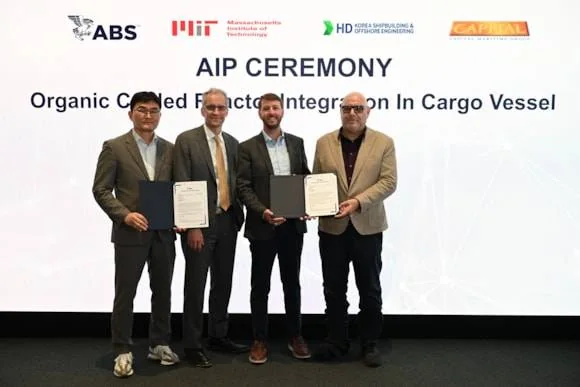
Nuclear power is set to revolutionize the maritime industry, as ABS has granted approval in principle (AIP) for the integration of a nuclear reactor into a cargo vessel propulsion system. This groundbreaking design, developed by the Massachusetts Institute of Technology (MIT), HD Korea Shipbuilding & Offshore Engineering (HD KSOE), and Capital Maritime Group, marks a significant milestone in the pursuit of sustainable shipping. The collaboration between academia and industry is expected to have far-reaching implications for the maritime sector, driving innovation and reducing environmental impact.
The MIT design utilizes a special synthetic fluid to carry heat from the reactor core, a departure from traditional designs that focus on micro-scale thermal outputs of 10 to 20 megawatts. This near-atmospheric operating pressure allows for thinner, lighter reactor vessels, facilitating modular construction and easier transport. Such advancements could significantly reduce the environmental footprint of cargo vessels, making them more efficient and sustainable.
ABS has reviewed the reactor-to-machinery interface based on class requirements, a critical aspect of ensuring the safety and reliability of the system. The approval in principle is part of the ABS New Technology Qualification (NTQ) service, which provides a structured approach to support the early adoption and implementation of innovative solutions.
The MIT Maritime Consortium, co-founded by ABS, HD KSOE, and Capital Maritime Group, brings together academia and industry to advance technologies with the potential to reshape the maritime sector. The consortium's focus on alternative fuels, new nuclear technologies, data-driven operational strategies, autonomy, cybersecurity, and onboard manufacturing is expected to drive innovation and reduce environmental impact.
The integration of nuclear reactors in cargo vessels could significantly reduce greenhouse gas emissions, making sustainable shipping a more viable option. As the world shifts towards cleaner energy sources, the maritime industry must adapt to meet growing demands for environmentally friendly transportation solutions.
ABS's approval in principle is a testament to the organization's commitment to supporting innovation and sustainability in the maritime sector. The AIP granted today marks an important step forward in the development of nuclear-powered cargo vessels, paving the way for a more sustainable future at sea.
The collaboration between MIT, HD KSOE, and Capital Maritime Group demonstrates the potential for academia and industry to work together to drive innovation and reduce environmental impact. As the maritime sector continues to evolve, it is essential that we prioritize sustainability and adopt technologies that minimize harm to the environment.
The integration of nuclear reactors in cargo vessels has significant implications for the future of sustainable shipping. With the growing demand for environmentally friendly transportation solutions, this technology could play a critical role in reducing greenhouse gas emissions and promoting a more sustainable maritime industry.
As the world continues to grapple with the challenges of climate change, innovative technologies like nuclear power are essential for driving sustainability in the maritime sector. The approval in principle granted today marks an important step forward in the development of nuclear-powered cargo vessels, and we can expect to see significant advancements in this area in the years to come.
The potential applications of this technology extend far beyond cargo vessels, with implications for the oil and gas industry, naval vessels, and other maritime sectors. As research and development continue, it is essential that we prioritize transparency and collaboration to ensure that these technologies are developed and implemented responsibly.
The integration of nuclear reactors in cargo vessels could significantly reduce greenhouse gas emissions.