

Waymo has published a groundbreaking article on its new reference model for human collision avoidance, titled 'Introducing Waymo’s New Reference Model for Human Collision Avoidance'. This joint research with TU Delft marks a significant leap in enhanced capabilities and increased realism for the established methodology. The ReD model is built upon the same predictive processing framework that powers the NIEON model, ensuring continuity in approach.
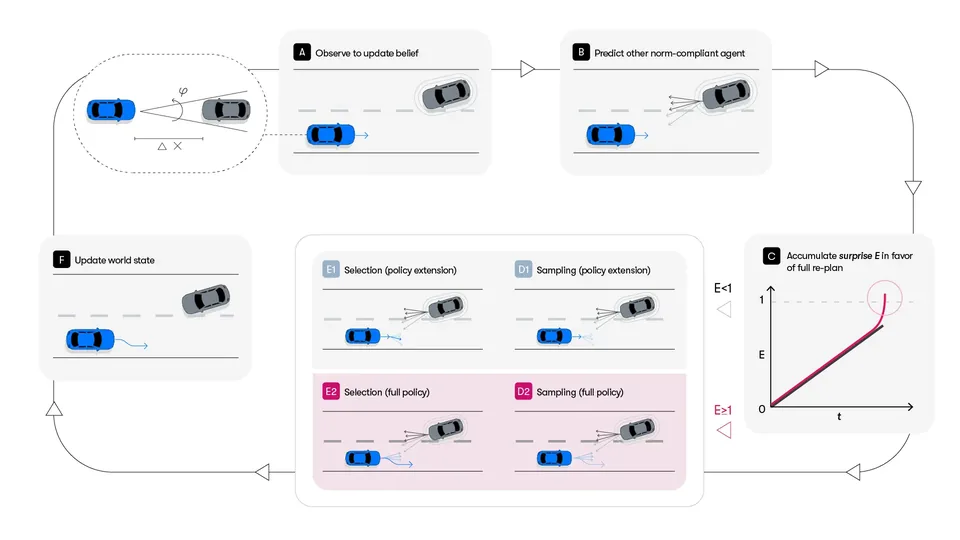
The central idea underlying these models is that human driving behavior can be generally understood as the minimization of surprise. While NIEON focuses on modeling when a human might react to a threat, ReD expands upon these capabilities to model the full closed-loop cognitive process.
ReD simulates how a careful and competent human driver updates their beliefs as a situation evolves, manages uncertainty about other road users’ intentions, and selects the evasive maneuver, whether that is braking, swerving, or a combination of both.

For decades, the automotive industry has used physical and virtual crash dummies to evaluate a car’s safety features, including its hardware and structural integrity. ReD evolves this concept, serving as a behavioral benchmark for autonomous driving systems able to realistically represent reasonable expectations on how a careful and competent human driver responds to traffic conflicts.
As a general model, ReD can be applied to various scenarios and environments, including those with significant uncertainty, for example, where the road conditions are poor or there is heavy traffic.
Waymo's commitment to safety and innovation is evident in its latest research, which has been published in the journal Nature Communications.
The company's mission of becoming the 'world's most trusted driver' is taking shape with this groundbreaking work.
This advancement strengthens Waymo's position in the autonomous vehicle industry, emphasizing its commitment to safety and innovation.
Waymo's safety research includes a dozen published papers on behavioral reference models, showcasing the company's dedication to improving collision avoidance capabilities.
The ReD model represents the latest advancement in Waymo's safety research, which is built upon the same predictive processing framework that powers the NIEON model.
This advancement strengthens Waymo's position in the autonomous vehicle industry, emphasizing its commitment to safety and innovation.