


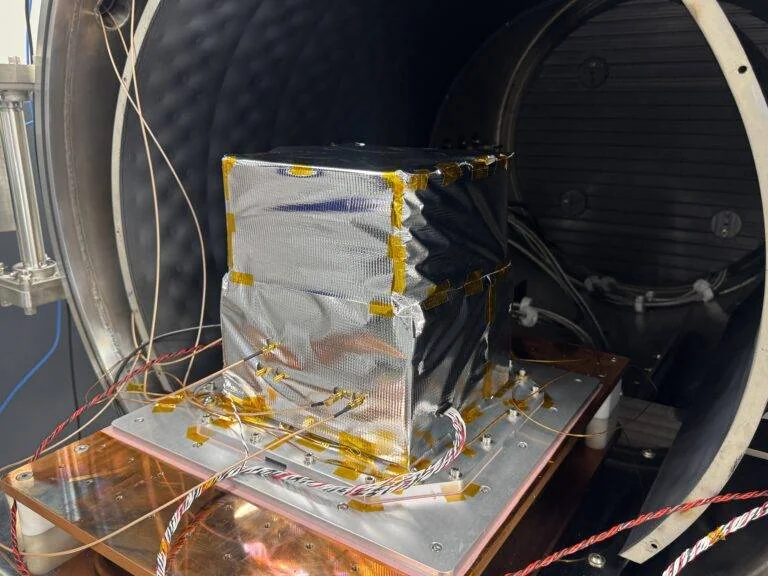
The Australian Government has deployed a new quantum clock technology developed by QuantX Labs in space, marking a major milestone in the country's efforts to enhance its space capabilities. TEMPO delivers up to 10 times the performance of current GNSS-based timing systems, providing more resilient communications, accurate navigation, and harder-to-disrupt synchronization between satellites and ground systems. This is crucial when GPS is jammed, spoofed or unavailable.
The deployment of TEMPO in space comes as the Australian Government released its 2026 National Defence Strategy and Integrated Investment Program last month, committing A$425 billion over the next decade to undersea warfare and resilient multi-orbit satellite communications. These priorities are expected to drive significant investment in quantum technology, with a focus on developing capabilities that can detect submerged targets in GPS-denied environments.
The Australian Government's commitment to enhanced space capabilities is also reflected in its Integrated Investment Program, which commits A$9-$12 billion to the development of a resilient, multi-orbit Australian defense satellite communications capability. Precision atomic clocks like TEMPO are foundational to keeping satellite constellations synchronized and communications secure under electronic attack.
QuantX Labs' quantum clock technology has been developed in partnership with Adelaide University, where Professor Nigel Spooner and Dr Erik Shartner are also working on developing quantum sensors for seabed mining and mud logging. These sensors enable real-time material identification and quantification, as well as near-real-time examination of borehole cuttings.
The development of quantum sensing technology has significant implications for the defence industry, particularly in terms of detecting submerged targets in GPS-denied environments. Quantum magnetometry is one of the most promising emerging technologies that can detect objects underwater without relying on traditional acoustic signatures.
Quantum sensors exploit the counterintuitive properties of quantum systems, which are sensitive to external disturbances. This sensitivity allows quantum sensors to detect extremely tiny changes and provide more precise readings than classical counterparts.
The integration of quantum technology in national defence will require significant investment and collaboration between industry and academia. As the technology continues to evolve, it is essential that stakeholders work together to ensure its safe and secure deployment.
Quantum sensing has the potential to revolutionize various industries beyond defence, including mining and oil and gas exploration. The development of quantum sensors for seabed mining and mud logging could lead to significant improvements in efficiency and accuracy.
The Australian Government's commitment to enhancing its space capabilities is a positive step towards ensuring the country's national security and economic interests are protected. As the technology continues to advance, it will be essential to monitor its development and deployment to ensure its safe and secure use.
The integration of quantum technology in national defence will require significant investment and collaboration between industry and academia.