
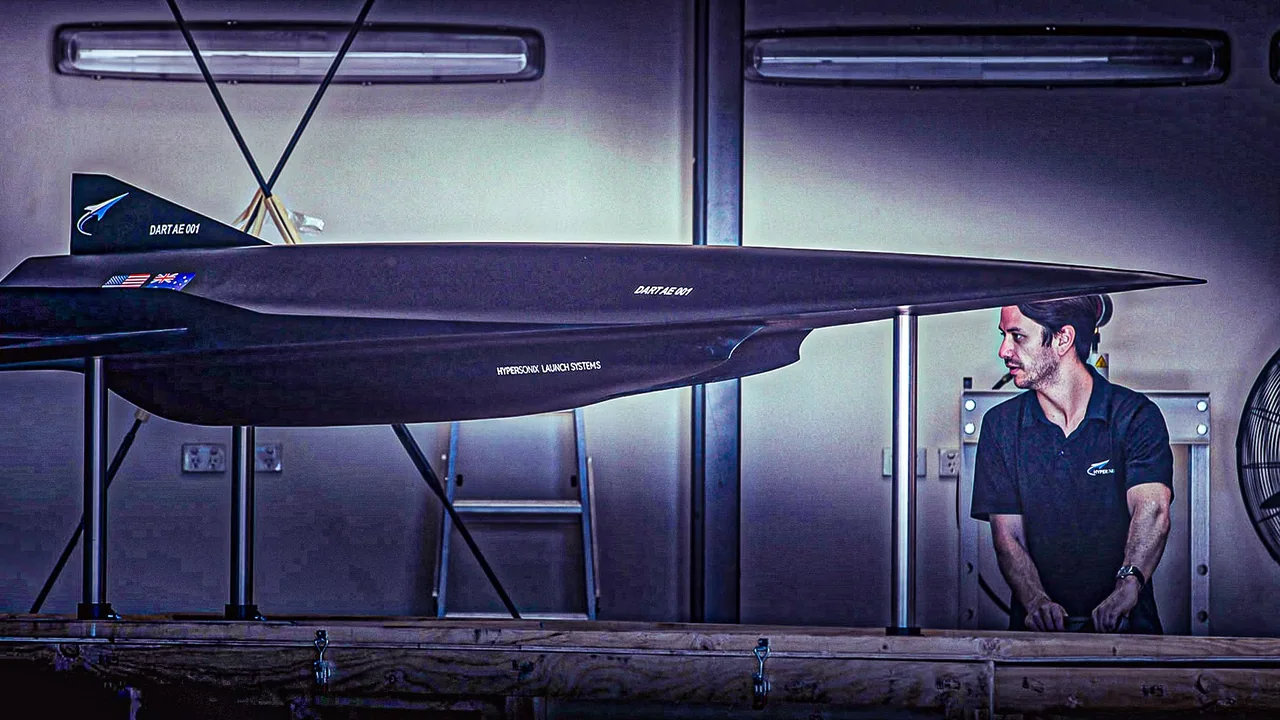
A revolutionary new aircraft is set to take the world by storm with its unprecedented speed capabilities. The Australian Hypersonix Launch Systems' DART AE demonstrator is a small, uncrewed vehicle built around the SPARTAN scramjet engine, which promises to reach speeds exceeding 12 times the speed of sound. This achievement would mark a significant milestone in hypersonic flight technology, paving the way for future innovations in transportation and beyond.
The primary objective of this development program is not to create a passenger-friendly aircraft but rather to serve as a recorder for flight data, providing valuable insights into the performance of scramjet engines at high speeds. Ground facilities are unable to replicate the extreme conditions required for hypersonic flight, making this project a crucial step towards validating the technology.
Hypersonix has emphasized the benefits of using green hydrogen in their engine, positioning this program as both a defense-relevant aircraft capability and a cleaner overall propulsion experiment. The use of renewable energy sources is expected to significantly reduce the environmental impact of future hypersonic flight programs.

A scramjet engine relies exclusively on a vehicle's forward speed to compress incoming air, making it a highly efficient but also volatile technology. The residence time for fuel injection and combustion is minuscule, requiring precise conditions to operate. Any changes in angle of attack or heating can seriously upset the combustion stability, highlighting the challenges associated with scramjet engines.
The DART AE demonstrator is an optimization and refitting of existing technology, building upon NASA's X-42A hydrogen-powered scramjet that reached speeds of Mach 9.6 in 2004. Hypersonix claims that this new aircraft will offer faster build cycles, more launches, and longer powered runs, marking a significant improvement over its predecessors.
The development of scramjet engines has been met with skepticism in the past due to their complexity and volatility. However, advancements in technology have made it possible to overcome some of these challenges, paving the way for further innovation in this field.

Scramjet engines are traditionally paired with rockets or other boosters to ensure stable operation. The DART AE demonstrator's ability to fly without such assistance is a testament to the progress made in scramjet engine technology.
The use of green hydrogen in scramjet engines has significant environmental benefits, reducing greenhouse gas emissions and minimizing the carbon footprint associated with future hypersonic flight programs.
As the world continues to push the boundaries of innovation, it will be exciting to see how this technology evolves and is applied in the years to come.

Scramjet engines require precise conditions to operate, making them challenging for development.