
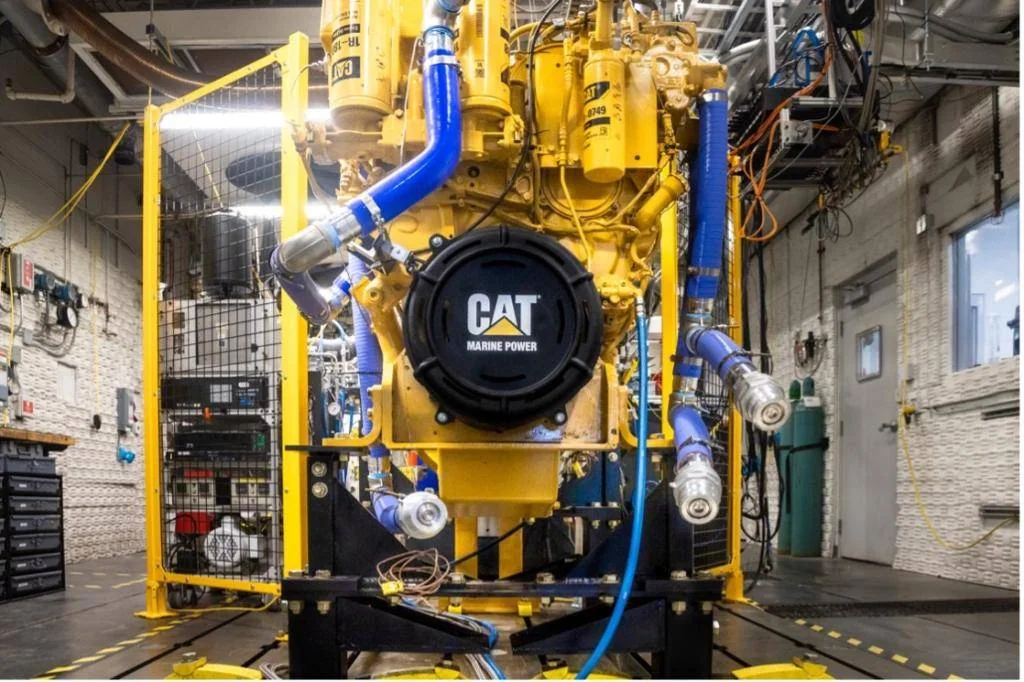
The development of a dual fuel combustion system by Oak Ridge National Laboratory (ORNL) in collaboration with Caterpillar Inc. is a significant breakthrough in addressing the challenge of methanol ignition in diesel engines. This innovation has clear relevance for inland and coastal marine vessels, which rely on compression-ignition diesel engines. The use of methanol as a fuel source poses a significant barrier to widespread adoption due to its difficulty in igniting. However, ORNL's approach pairs methanol with a small amount of diesel used as a pilot fuel to start combustion, enabling methanol dual fuel operation across a much wider range of conditions.
The benefits of using methanol as a fuel source are numerous. Methanol is typically produced from natural gas, an abundant domestic resource, and converting it into a liquid allows easier storage and handling. This makes methanol an attractive alternative to traditional diesel fuels, particularly for vessels that require long-term storage and transportation. However, the challenges associated with methanol ignition must be addressed in order to realize its full potential.
ORNL's dual fuel system has been designed to overcome these challenges. By pairing methanol with a small amount of diesel used as a pilot fuel, the system enables methanol dual fuel operation across a much wider range of conditions. This approach allows marine engines to use more than 75 percent methanol under various power levels and without reducing performance.
The project was led by ORNL's Derek Splitter, who noted that the system 'allows marine engines to use more than 75 percent methanol under a wide range of power levels and without reducing performance.' This achievement is significant, as it demonstrates the potential for methanol dual fuel systems to significantly reduce emissions and operating costs for marine vessels.
Although deployment of this technology would require engine updates, ORNL's approach avoids a full redesign of diesel engines. Instead, the system can be integrated into existing engines, allowing them to operate on either diesel or dual-fuel methanol. This makes it an attractive option for vessel owners and operators who want to reduce their environmental impact without incurring significant upfront costs.
The development of this technology has far-reaching implications for the marine industry. As concerns about climate change and air pollution continue to grow, vessel owners and operators are under increasing pressure to adopt more sustainable fuels and technologies. The methanol dual fuel system represents a significant step forward in addressing these challenges.
Furthermore, the use of methanol as a fuel source can help reduce dependence on imported fossil fuels, which can have significant economic and security implications for coastal regions. By promoting the use of domestic resources like natural gas, this technology can also support economic development and energy security.
The next steps will be to further refine and test the dual fuel system in real-world applications. ORNL and Caterpillar Inc. are already working together to explore the potential of this technology for various marine applications. As the maritime industry continues to evolve, it is likely that we will see more innovations like this one that address the challenges of sustainable fuels and emissions reduction.
The methanol dual fuel system represents a significant breakthrough in addressing the challenge of methanol ignition in diesel engines. Its development has the potential to significantly reduce emissions and operating costs for marine vessels, while also promoting the use of domestic resources and reducing dependence on imported fossil fuels.
This technology has the potential to significantly reduce emissions and operating costs for marine vessels.